
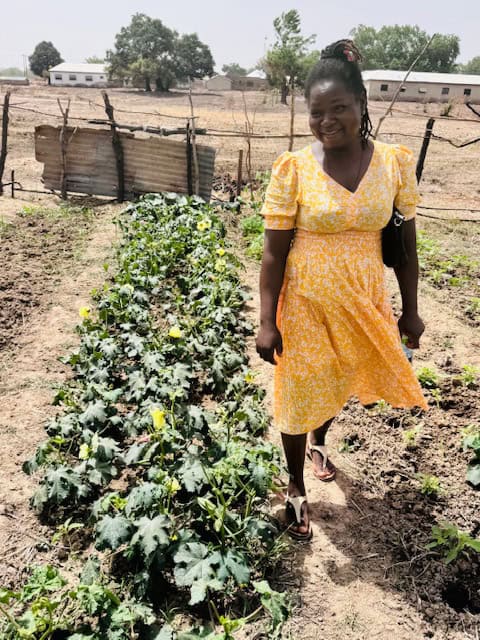
During the long dry season in Ghana’s Upper West Region, access to fresh vegetables becomes limited, household nutrition declines, and income opportunities for rural families are scarce.
To address this challenge, Self-Help International is piloting an irrigated garden demonstration near Dantie Dam, where water is pumped through channels to irrigate sunken vegetable beds.
The garden provides a practical training opportunity in the community where local farmers, particularly women, learn climate-smart dry season gardening techniques with the potential to improve their food security, nutrition, and household income year-round.
The demonstration garden features a diverse range of heat-tolerant vegetables adapted for irrigated dry season production in the harsh savanna climate, including okra, tomatoes, amaranth, spring onions, carrots, garden egg (eggplant), cabbage, cassava leaves, cowpea (black-eyed pea) leaves, pumpkin leaves, and other leafy greens.
By growing multiple crops in adjacent plots, Self-Help extension staff model crop diversification, staggered planting, and continuous harvesting strategies that allow families to produce food throughout the dry season. These gardens provide nutritious vegetables for home consumption while also generating small but meaningful incomes that families use to pay school fees, cover hospital bills, and meet household needs.
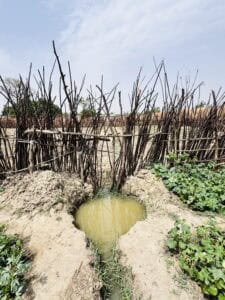
The Dantie Dam site functions as a learning space for farmers participating in Self-Help International’s Agriculture and Entrepreneurship Development (AED) program. Ten local families currently participate in the demonstration, learning sustainable climate-smart techniques for dry season irrigated gardening, including: sunken bed preparation, composting and permanent soil cover, biochar production and application, low-till cultivation, inter-cropping, seed spacing, crop rotation, weed management, double row planting, and integrated pest management.
The plot allows farmers to learn alongside Self-Help Agriculture Extension Officers Lawrence Zongo and Emmaculate Etaah as they model best practices and monitor irrigation and water use efficiency, soil management, plant growth, and yield improvements in real time.
The demonstration also serves as an educational resource for youth in the community. In partnership with the local junior high school, the students have their own dedicated garden for hands-on learning. The students learn to cultivate their own plots and gain practical agricultural skills and environmental and life science knowledge.
This experiential approach strengthens learning, enables technology transfer, builds interest in agriculture as a sustainable livelihood, and helps students understand the importance of nutrition, food production, and environmental stewardship. By engaging students alongside local farmers, Self-Help International is fostering the next generation of agricultural leaders in the Upper West Region.
Powered by Wapiti Digital #servetheherd

This is my rich text.
This is more rich text.
I am a list
Lists are cool